
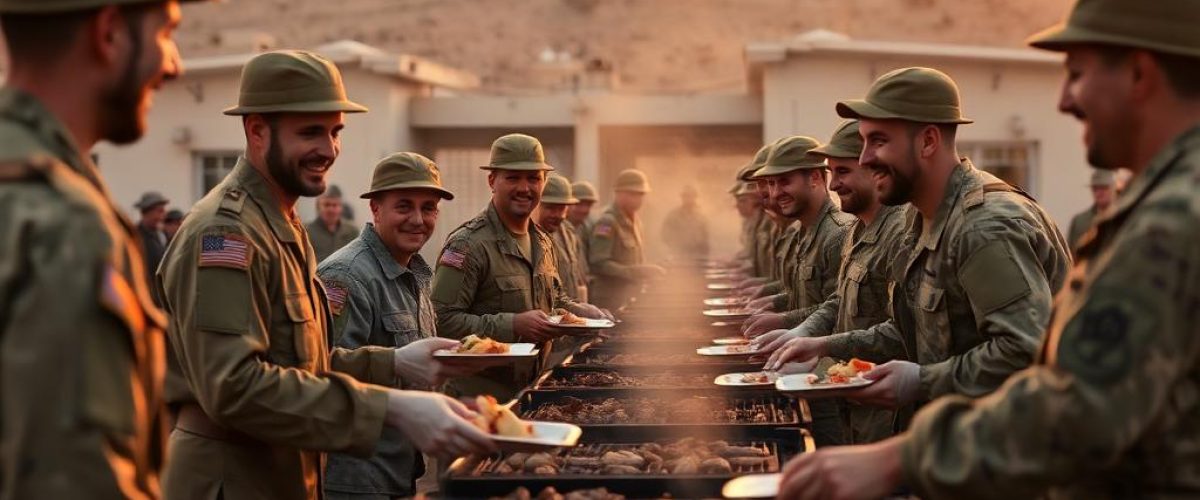
Looking back at our early days feels like remembering a different lifetime. When we first set out to serve IDF soldiers, we had nothing more than a single grill, a small team of dedicated volunteers, and an unwavering belief that food could make a difference. Reaching our first thousand meals seemed like an impossible dream.
The Spark That Started It All
It began with a simple observation during a visit to a military base in 2020. Soldiers were eating packaged rations—nutritious, yes, but lacking the warmth and comfort of a home-cooked meal. I remember watching a young soldier’s face as he opened another vacuum-sealed package, and something clicked.
What if we could bring them something better? What if we could give them a taste of home, right there on the base?
The First Event
Our first BBQ event was modest by any measure. We borrowed a single charcoal grill from a friend, purchased ingredients with our own money, and drove to a small base in central Israel. We didn’t know what to expect.
What we found was overwhelming gratitude. Soldiers lined up not just for the food, but for the human connection. They wanted to talk, to share stories, to feel acknowledged by civilians who cared enough to show up.
Lessons From Day One:
- **Preparation matters**: We underestimated how much food soldiers would eat
- **Quality over quantity**: Fresh, well-seasoned meat speaks louder than volume
- **Personal touch**: A smile and genuine interest meant as much as the food itself
- **Kosher commitment**: Maintaining standards was non-negotiable from the start
Scaling Up: The First 100
After that first event, word spread. Other bases heard about what we were doing and invited us. Volunteers started reaching out, wanting to help. Within two months, we had served our first hundred meals.
The logistics were challenging. We were still operating out of personal vehicles, buying ingredients at retail prices, and coordinating everything through text messages and phone calls. But the energy was incredible. Every volunteer who joined brought new ideas, new connections, new resources.
The Systems We Built
Reaching a thousand meals required building actual systems:
Supply Chain: We negotiated with kosher suppliers who believed in our mission. Some offered discounted prices; others donated outright.
Equipment: We invested in professional-grade portable grills that could handle volume. Our single borrowed grill became a fleet of six.
Volunteer Coordination: What started as informal WhatsApp groups became structured scheduling systems with designated team leads.
Transportation: We secured donated van space and eventually acquired our first dedicated vehicle.
The Human Stories
The numbers tell one story, but the individual moments tell another entirely.
There was the soldier who broke down in tears when he tasted our grilled chicken—it reminded him of his grandmother’s cooking, and she had passed away just months before his enlistment.
There was the base commander who initially seemed skeptical but became our biggest advocate, personally calling us whenever his soldiers needed morale support.
There was the young volunteer who had never grilled before and is now one of our lead chefs, responsible for training new team members.
Challenges and Breakthroughs
Every milestone came with obstacles:
Challenge: Maintaining kosher standards while scaling up
Breakthrough: Partnering with certified mashgichim who volunteered their time
Challenge: Reaching remote bases with limited infrastructure
Breakthrough: Developing self-sufficient mobile kitchen setups
Challenge: Funding operations without official non-profit status
Breakthrough: Community members who trusted our mission and gave generously
Challenge: Coordinating with military security protocols
Breakthrough: Building relationships with commanders who vouched for us
The Thousand-Meal Milestone
When we served our thousandth meal, we almost didn’t realize it. We were at a base in the north, the sun was setting, and soldiers were coming back for seconds. Someone did the math and announced we had just crossed the threshold.
There was no fanfare—just a moment of quiet appreciation among the volunteers. We had proven something: this idea could work at scale.
What We Learned
Those first thousand meals taught us everything we needed to know for the next 233,000:
1. Mission clarity: Know exactly why you’re doing this, and never lose sight of it
2. People first: The right volunteers are worth more than the best equipment
3. Adapt constantly: What works at one base might not work at another
4. Celebrate small wins: Every meal served is a victory
5. Stay humble: We’re guests on these bases, privileged to serve
The Foundation for Growth
Everything we do today—the multiple daily events, the displaced family programs, the scaled operations—rests on the foundation we built during those early months. The relationships we formed, the systems we created, the lessons we learned.
Most importantly, we proved that civilians could make a meaningful difference in the lives of those who serve. That a hot meal, prepared with love and served with gratitude, carries weight far beyond its nutritional value.
Looking Back, Moving Forward
Today, when I visit a base and see our team serving hundreds of meals with professional efficiency, I sometimes think back to that first small grill, those first few volunteers, that first soldier’s grateful smile.
The scale has changed dramatically. The mission hasn’t changed at all.
We’re still doing exactly what we set out to do: bringing the taste of home to those who defend it, one meal at a time. The first thousand proved it was possible. Everything since then has proven it’s essential.