
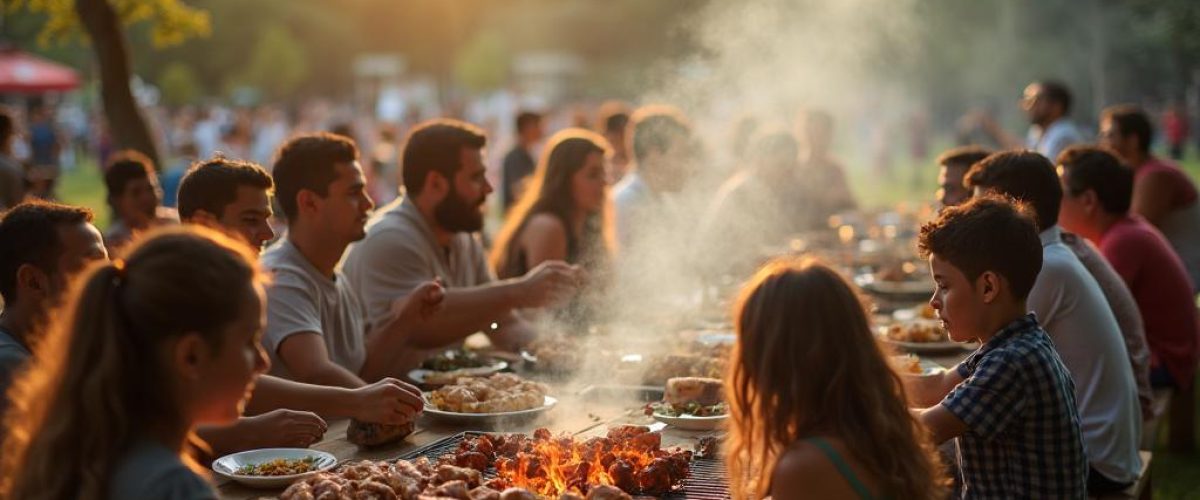
There’s a reason humans have gathered around fires to cook and eat together since the dawn of civilization. Food creates community in ways that nothing else can. At Grilling for Israel, we witness this transformative power every single day.
The Ancient Bond of Shared Meals
In Jewish tradition, eating together is never merely functional. The Shabbat table, the Passover seder, the break-fast after Yom Kippur—these meals carry spiritual and communal significance that transcends the food itself. We tap into this ancient wisdom every time we fire up our grills.
When we serve soldiers at a base, we’re not just providing nutrition. We’re creating a communal experience that echoes countless generations of shared meals. When we feed displaced families at evacuation centers, we’re rebuilding the sense of community that displacement tried to destroy.
How Food Breaks Down Barriers
Watch any of our events closely, and you’ll see magic happen. Soldiers from different units who barely know each other start conversations over the serving line. Displaced families who’ve been isolated in their hotel rooms suddenly find themselves chatting with neighbors they hadn’t yet met.
The informality of BBQ is part of its power. There’s something about standing around a grill, plates in hand, that puts people at ease. The smell of grilling meat, the sizzle and smoke, the casual serving style—it all signals: this is a time to relax, to connect, to be human.
The Social Science of Communal Eating:
- **Breaking bread together** reduces perceived social distance between strangers
- **Shared eating experiences** create lasting positive associations between people
- **Informal meal settings** encourage authentic conversation over formal pleasantries
- **The act of serving** creates bonds of gratitude and reciprocity
Creating Space for Connection
Our events are designed to maximize interaction:
Serving Lines: Unlike cafeteria-style distribution, our lines move slowly enough for brief exchanges. Volunteers learn names, ask questions, make eye contact.
Common Seating: We set up communal eating areas that encourage people to sit together rather than retreat to private corners.
Lingering Time: We don’t rush. People are welcome to come back for seconds, thirds, to stay and talk. The grill keeps producing as long as people keep gathering.
Volunteer Visibility: Our team doesn’t hide in the back. We’re present, approachable, part of the community we’re serving.
The Volunteer Community
The community-building extends to our volunteers as well. People who might never have met—retirees and students, secular and religious, longtime Israelis and recent immigrants—come together around our shared mission.
Volunteers often tell us that their Grilling for Israel shifts are the highlights of their weeks. The camaraderie, the shared purpose, the joy of serving together—it creates bonds that extend far beyond our events.
Stories of Connection
The Adopted Grandmother: Rachel, 72, started volunteering after her husband passed away. She now has “adopted” several soldiers who call her Safta (grandmother) and visit her on their leaves.
The Study Group: Four university students who met volunteering together now study for exams in each other’s apartments. They credit their friendship entirely to a random shift assignment.
The Business Partnership: Two entrepreneurs who met at a volunteer appreciation event are now building a startup together.
The Marriage: Yes, we’ve had couples who met at our events go on to marry. Food brings people together in more ways than we can count.
Community for Displaced Families
For families forced from their homes, community loss is often as painful as property loss. Their neighbors are scattered, their schools closed, their synagogues or mosques empty. The informal networks of support that sustain daily life—who watches your kids when you need to run an errand, who you chat with at the corner store—all of that disappears.
Our events at evacuation centers do more than provide meals. They create gathering points where community can reform. Families discover that other families from their town are staying in the same hotel. Parents connect with other parents facing the same challenges. Children find playmates.
We’ve watched new communities form around our BBQ events—informal support networks that continue long after we pack up our grills.
The Ripple Effects
The connections formed at our events create ripple effects we can’t always see:
- Soldiers return to their units with improved morale, making them more effective team members
- Volunteers share their experiences with friends and family, building broader community support
- Displaced families find the social connections they need to navigate their difficult situations
- Commanders see the impact and become advocates for morale-supporting initiatives
Food as Language
In a country with multiple languages, religious traditions, and cultural backgrounds, food serves as a universal language. Our BBQ is Israeli in a way that transcends specific identities—the grilled meats, the fresh salads, the warm pita.
A Druze soldier and a Haredi volunteer might struggle to find common ground in conversation, but they both appreciate perfectly grilled chicken and fresh hummus. That shared appreciation creates a foundation for the conversation that might follow.
Building Bridges to the Future
Every meal we serve plants seeds for future connection. The soldier who ate our BBQ might one day tell his children about the civilians who showed up to support him. The displaced family might remember, years from now, the community that formed around those hotel courtyard meals.
We’re not just feeding the present. We’re building the memories and connections that will sustain community into the future.
The Heart of Our Mission
When people ask what Grilling for Israel really does, the easy answer is: we serve kosher BBQ to soldiers and displaced families. The deeper answer is: we build community through food.
We create spaces where people can be human together. We use the ancient power of shared meals to forge connections that might not otherwise exist. We demonstrate, plate by plate, that no one is alone—that a caring community surrounds everyone who serves or suffers.
This is the heart of our mission, and it’s why every meal matters.